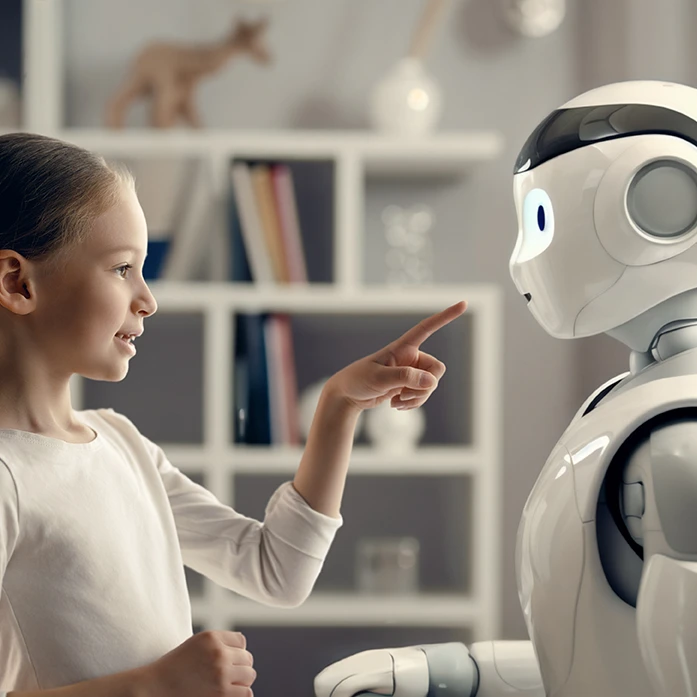
Artificial intelligence is rapidly moving beyond software and into the physical world. From humanoid robots and autonomous mobile robots to advanced industrial automation systems, intelligent machines increasingly depend on sophisticated sensing, circuitry and connectivity technologies to see, feel, move and respond to their environment.
Physical AI, often referred to as embodied AI, requires technologies capable of linking intelligence with real-world interaction. Humanoid robots, autonomous mobile robots (AMRs) and advanced automation systems must do more than process information. They need to perceive their environment, interact safely with objects and people, and transmit large volumes of data while continuously moving.
This places significant demands on the technologies inside them. More sensors and processing capability must be integrated into increasingly compact platforms. High-speed signals must pass reliably through moving joints. Electronic systems must withstand repeated bending and twisting. And robots must interact with the physical world with ever greater precision.
Fujikura supports this evolution through flexible printed circuits, membrane sensing technologies, micro-coaxial cable assemblies and compact connector solutions. Together, these technologies provide the sensing, signal transmission and interconnect performance needed to turn artificial intelligence into capable physical systems.
Giving robots a more human sense of touch
For a robot to handle objects safely, it must be able to detect and respond to force. Much like the human sense of touch, tactile sensing allows machines to understand physical interaction rather than simply execute programmed movement. Fujikura membrane sensing technology provides accurate force and touch detection through a flexible, conformable sensor structure. Integrated into robotic grippers, hands and contact surfaces, it can help a machine recognise how firmly it is holding an object and adjust its grip accordingly.
This capability is particularly valuable when handling fragile, irregular or easily damaged items. By providing more precise tactile information, membrane sensors can support safer and more delicate interaction in humanoid robotics, factory automation and other physical AI applications.
The technology is produced using an efficient additive printing process on flexible film. This combination of sensitivity, conformability and scalable manufacture makes it a compelling solution for designers seeking to build tactile intelligence into compact robotic systems. Fujikura’s membrane technology is a versatile printed-electronics platform that can be formed, shaped and integrated with additional mechanical components.
Reliable data through constantly moving joints
Vision systems, LiDAR, cameras and other sensors generate the high-speed data that physical AI platforms use to understand their surroundings. In embodied systems, that information may need to travel through a rotating head, articulated arm, wrist or other tightly constrained moving joint. Maintaining signal integrity in these environments is a significant engineering challenge. Conventional cables can occupy valuable space, pick up electromagnetic noise or suffer mechanical fatigue following repeated bending and twisting.
Fujikura custom micro-coaxial cable assemblies are engineered to transmit high-speed data through these complex kinetic environments. Their miniature construction, mechanical flexibility and electromagnetic shielding help maintain signal integrity while allowing reliable operation in compact, continuously moving assemblies.
Assemblies can be terminated with connectors selected for the customer’s board layout, helping reduce complex micro-soldering during production and simplifying final installation. The result is a compact, application-specific and plug-and-play interconnect solution.
Fujikura micro-coaxial cables provide robotics interconnects for applications requiring miniaturisation, high-speed data transmission with signal integrity, electromagnetic compatibility and strong bending and twisting performance. They can also combine data and power lines within the same customised harness.
More functionality in less space
In robot design, every millimetre matters inside a humanoid robot or autonomous platform. Fujikura flexible printed circuits help designers integrate electronic functionality into compact and mechanically complex structures. Their lightweight, thin and flexible construction allows circuitry to follow the shape of the application, making more efficient use of the available space.
FPCs can help reduce wiring complexity, support high-density circuit layouts and provide reliable connections between sensors, control boards and other electronic components. They can also be developed around the specific mechanical, electrical and environmental demands of the application.
With more than 40 years of FPC manufacturing experience, Fujikura develops application-specific circuits that range from highly miniaturised, high-density designs to larger-format, high-power and temperature-resistant solutions.
For developers of physical AI platforms, this design flexibility supports smaller and lighter robotic assemblies while enabling the integration of increasingly sophisticated sensing, computing and control electronics.
Connecting intelligent systems with confidence
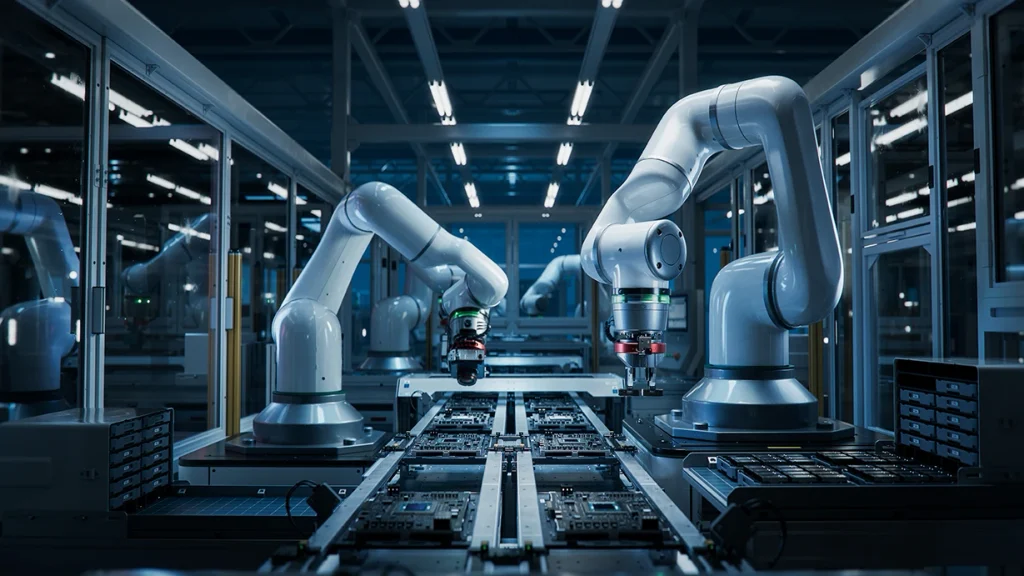
Robotic platforms rely on a growing network of connections for signals, sensors, cameras, control systems and power distribution. These connections must be compact, reliable and easy to assemble, maintain and service. Fujikura’s connector portfolio includes high-density, fine-pitch, industrial, circular, FPC/FFC and coaxial solutions suitable for applications including manufacturing equipment, industrial robotics and automation machinery.
By combining compact dimensions, high reliability and application-specific configurations, these connectors help engineers build robust interconnect architectures that are easier to assemble, maintain and scale as robotic complexity increases. These robotics connectivity solutions can support increased functionality without unnecessarily increasing the size or complexity of the finished system.
Engineering intelligence into motion
The next generation of intelligent machines will require far more than powerful AI models. They will depend on sensing technologies that provide awareness of the physical world, flexible circuitry that enables compact designs, high-speed interconnects that protect data integrity during continuous movement, and connector systems that support increasingly complex electronic architectures.
Through expertise in sensing, flexible circuitry and advanced connectivity, Fujikura is helping engineers overcome these physical challenges. Together, these technologies provide the foundation for robots and autonomous systems that can interact with their environment more naturally, operate more reliably and deliver greater levels of intelligence in real-world applications.
At Electronica, visitors can discover how Fujikura technologies are helping bridge the gap between digital intelligence and physical action.