The automotive industry is undergoing a fundamental transformation with electrification changing how vehicles are powered and charged. Advanced electronics are engaging more systems and functions and IoT is connecting vehicles and their surroundings to bring revolutionary changes to our traveling habits. We, the consumers, are essentially along for the ride and because driving is more than a means to get from A to B, car manufacturers must meet a range of expectations.
It is not enough to simply add new features. Vehicle manufacturers and their technology partners must integrate greater and more intuitive functionality into increasingly compact spaces, while maintaining the reliability, safety and performance demanded by automotive applications.
Fujikura supports this transformation through flexible printed circuits, advanced membrane technologies and high-power EV charging connectors. Together, these technologies help manufacturers address some of the most important challenges shaping modern mobility.
Reliable connections for increasingly intelligent vehicles
As vehicles become more connected and software-defined, the number and complexity of their electronic systems continue to grow. Advanced driver-assistance systems, infotainment, sensors, lighting and battery applications all depend on consistent electrical performance.
Fujikura flexible printed circuits, or FPCs, provide reliable connections while supporting compact, lightweight and complex electro-mechanic functionality. Their flexibility allows them to conform to complex geometries and fit into spaces where conventional wiring or rigid circuit boards would be impractical.
Designed to withstand demanding automotive environments, including temperature extremes, vibration and mechanical stress, Fujikura FPCs combine design versatility with a proven track record in high-reliability applications. They can also integrate multiple functions within a single circuit, helping manufacturers reduce component count and simplify design. Fujikura’s automotive FPCs support applications ranging from infotainment and advanced driver-assistance systems, to illumination and battery monitoring.
Controls that become part of the vehicle
The relationship between driver and vehicle is also changing. Drivers increasingly expect controls to blend seamlessly into interior surfaces, becoming visible or active only when needed.
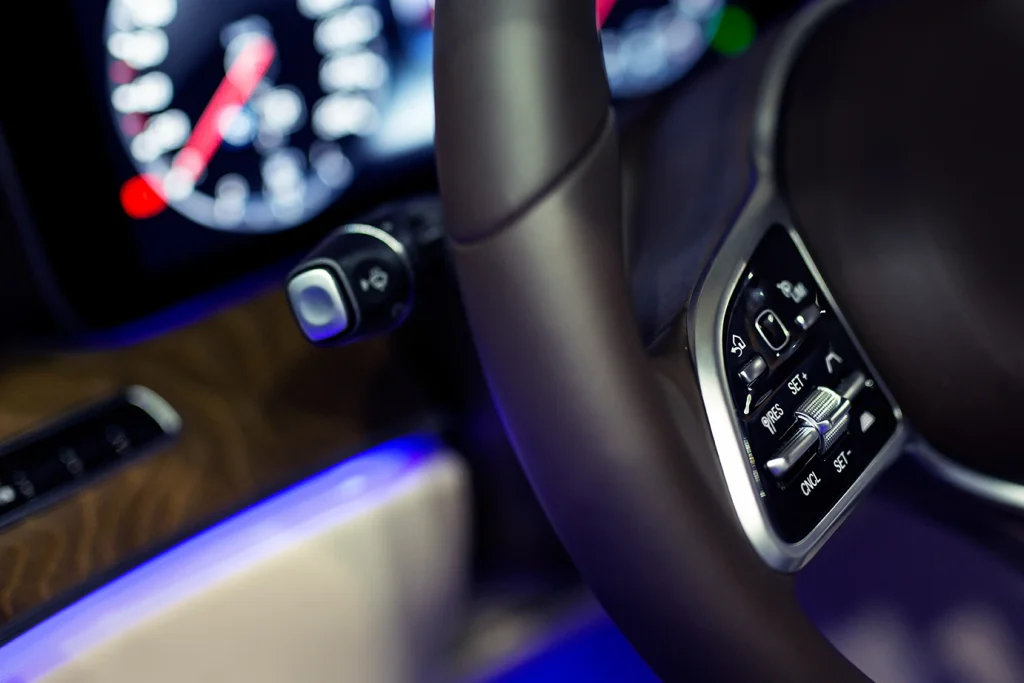
Fujikura membrane technology enables switches, sensors and other functionality to be printed onto thin, flexible films. These films can be formed and integrated into curved surfaces and components, providing vehicle designers with greater freedom to create clean, sophisticated interiors.
This approach supports hidden interfaces that preserve the intended aesthetic of the cabin while providing intuitive control. It also creates opportunities to combine functions. Within steering wheel applications, for example, Fujikura integrates heating and hands-on detection functionality into a single thin-film element.
For manufacturers, this can reduce complexity and support more efficient integration. For drivers, it contributes to an experience that feels natural, comfortable and responsive.
Supporting safer, more comfortable journeys
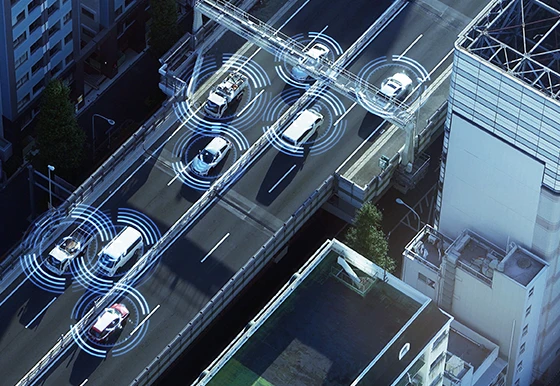
Automotive electronics do more than add convenience. They also play an important role in vehicle safety and operational integrity. Reliable circuitry helps ensure sensors, cameras and driver-assistance systems communicate and perform as intended.
Hands-on detection supports the effective use of driver-assistance functionality, while integrated heating can improve driver comfort without requiring a separate system.
By bringing sensing, heating and control functions together within flexible, space-efficient architectures, Fujikura technologies help manufacturers develop vehicles that are not only more advanced, but also safer and more intuitive.
Making high-power EV charging easier
The transition to electric mobility depends as much on charging infrastructure as it does on the vehicles themselves. Fujikura CCS2 and CHAdeMO DC charging connectors combine high-power charging performance with lightweight cable technology, robust construction and ergonomic handling. They are engineered for efficient power transfer, dependable operation and compatibility with recognised charging standards.
For charge-point operators and infrastructure manufacturers, durability and long service life can help reduce maintenance and downtime. For EV drivers, lightweight cables and user-friendly connector designs can make the charging process trouble free.
Built on more than a decade of charging connector development, Fujikura’s solutions are contributing accelerate the transition to reliable, accessible electric mobility.
Engineering the road ahead
Electrification, connectivity, safety and the driver experience cannot be addressed in isolation. Each depends on components that perform reliably, integrate efficiently and make intelligent use of limited space.
Through proven FPC technology, versatile, printed electronics and high-performance EV charging connectors, Fujikura helps automotive manufacturers turn these interconnected requirements into practical, production-ready solutions.
Discover Fujikura automotive technologies at Electronica this November.